
Fandom in the Edo Period? Asakusa: The Sacred Ground for Iconic Beauties
Updated: Jan 3
Ukiyo-e prints reveal the "Idols You Can Actually Meet" from the 18th century.
In the Edo period (1603–1868), Asakusa was not only the center of faith and entertainment but was also widely celebrated as a district of "Famous Beauties." This vibrant culture is preserved in Ukiyo-e (woodblock prints), the mass media of the time. Among the women celebrated as the "Three Great Beauties of Edo," stars associated with Asakusa appeared time and time again.
The Broad Definition of "Asakusa" in the Edo Period
It is important to note that "Asakusa" in the Edo period referred to a much larger area than it does today. While modern-day Asakusa centers on the 1st to 7th districts of Taito City, from the Edo period to the early Meiji era, it encompassed a vast region on the west bank of the Sumida River, including Moto-Asakusa, Kotobuki, Komagata, Hanakawado, Kaminarimon, and Senzoku.
For people back then, it was common to view the entire area—stretching from Senso-ji Temple toward Ueno and Yanaka—as a single, continuous cultural zone. This grand "sphere of leisure and faith" served as a massive trend-setting hub.
The Idols of Asakusa Born from Tea House Culture
The primary reason Asakusa became synonymous with beauty was its thriving tea house culture. Numerous Chaya and Mizu-chaya lined the gates and precincts of Senso-ji Temple, bustling with pilgrims and tourists.
In modern terms, a Chaya was like a restaurant, while a Mizu-chaya was more like an open-air cafe.
The young women working there, known for their hospitality and striking looks, gained fame through word-of-mouth. Eventually, they were depicted by Ukiyo-e artists, becoming "famous beauties" (hyoban-bijin) known throughout the city.
In modern terms, they were like "Idols you can meet" or "Influencers." There was a physical place to meet them, their popularity spread through social reputation, and they were "visualized" through the medium of Ukiyo-e. This ecosystem is strikingly similar to today’s idol culture.
The Three Great Beauties of the Meiwa Era (1764–1772)
During the mid-Edo period, three women became legendary stars:
Osen of Kasamori: The poster girl of the "Kagiya" tea house in front of Kasamori Inari Shrine in Yanaka. At the time, Yanaka was a popular walking area frequently visited alongside Senso-ji, making Osen a cross-regional star.
Ofuji of Yanagiya: The poster girl of "Yanagiya," a tooth-stick (early toothbrush) shop within the Senso-ji precincts.
Oyoshi of Tsutaya: A tea house girl from the "Nijuken-chaya" row in the Senso-ji precincts.
(Note: Theories vary regarding the third beauty; some accounts name Okiyo of Suppon, another Asakusa star.)
These women served as models for Nishiki-e (full-color woodblock prints), which acted like the "celebrity portraits" of the era. Men flocked to Asakusa and Yanaka in a form of early "fandom" just to catch a glimpse of their favorites.

Artwork: Suzuki Harunobu, Osen, Kikunojo, and Ofuji, Yoko-oban Nishiki-e, Meiwa era (1764–1771).Collection of the Tokyo National Museum.
The Three Great Beauties of the Kansei Era (1789–1801)
As the era shifted, a new trio rose to fame, immortalized by the legendary artist Kitagawa Utamaro:
Okita of Naniwaya: A girl at the tea house next to the Zuishin-mon Gate (near the current Hozomon Gate) of Senso-ji Temple.
Ohisa of Takashimaya: The poster girl of the "Takashimaya" rice cracker shop in Ryogoku Yagenbori.
Tomimoto Toyohina: A celebrated geisha from Yoshiwara and a master of Tomimoto-bushi (a style of narrative singing).
Among them, Okita of Naniwaya enjoyed overwhelming popularity. It is said that long queues formed in front of her tea house just for a chance to be served tea by her.
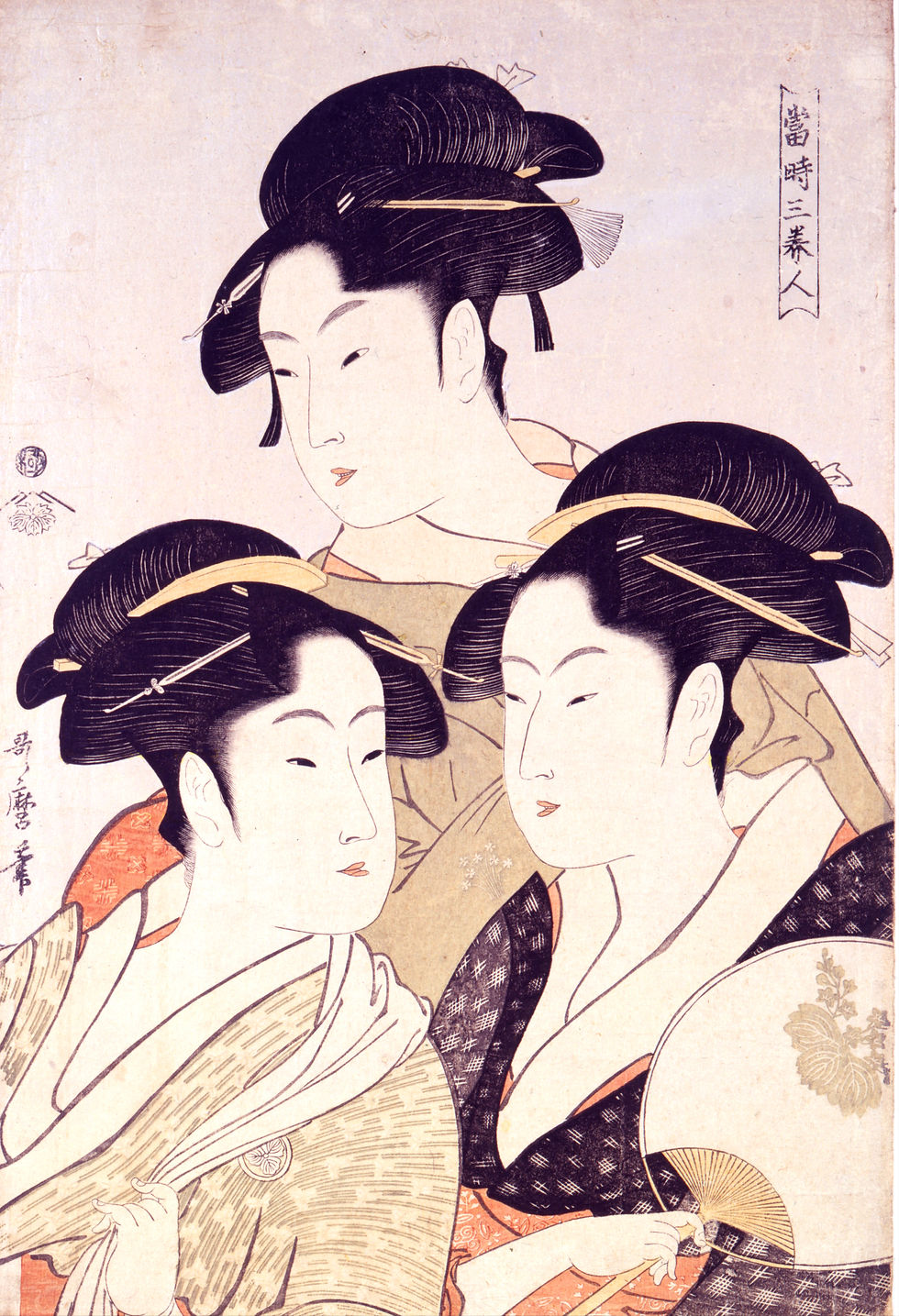
Artwork: Kitagawa Utamaro, Three Beauties of the Present Day (Kansei San Bijin), Kansei 5 (1793).
Asakusa: The Trend-Setting Hub of Edo
It is no coincidence that beauties from Asakusa repeatedly dominated the spotlight across different eras. Asakusa possessed all the perfect conditions for creating icons:
An overwhelming concentration of people.
Intense word-of-mouth reputation.
A media presence (Ukiyo-e) that recorded their existence for posterity.
The "Idols of Edo" were born here because Asakusa was a place where stars could be created, met, and talked about.
Travel Tip:
The "Zuishin-mon" gate where Okita worked is the site of the current Hozomon Gate. As you walk through the bustling Nakamise-dori and pass under the Hozomon toward the Main Hall, take a moment to imagine the tea houses that once stood here—and the "Idols you could meet" who once shined so brightly in the heart of Edo.
【References & Related Links】


