
What Was Asakusa Like Before Edo? Following in the Footsteps of Archaeologist Torii Ryuzo
Asakusa was Asakusa long before the Edo period: a place where people gather and culture takes shape
Today, Asakusa is one of Tokyo’s best-known destinations. It is often described as a neighborhood where the atmosphere of old Edo survives. Follow its history further back, however, and a somewhat different Asakusa comes into view.
Asakusa was not a town created by Edo.
People were living and working here long before the great city of Edo came into being. In time, people gathered around Senso-ji Temple, craftspeople made their homes here, and people and goods traveled along the Sumida River. A town with a character of its own took shape.
About a century ago, one scholar argued that Edo and Asakusa had originally developed as places of different character, and that their histories needed to be considered separately.
He was the anthropologist and archaeologist Torii Ryuzo.

Torii Ryuzo’s search for Asakusa before Edo
Torii Ryuzo (1870–1953) was a pioneer of Japanese anthropology and archaeology, active from the Meiji through the Showa eras. Born in Tokushima, he worked in the anthropology laboratory at Tokyo Imperial University. His fieldwork took him not only across Japan but also through Taiwan, the Korean Peninsula, Manchuria, Mongolia, Siberia, and other parts of East Asia.
A defining feature of Torii’s research was direct observation. He walked the land and studied its contours. He investigated archaeological sites and burial mounds. From the traces people had left behind, he considered how a place had taken shape.
Tokyo was also an important subject for Torii. He visited the Asakusa area, investigating Matsuchiyama, the grounds of Senso-ji, Denbo-in, and Bentenyama. When buildings burned in the Great Kanto Earthquake and landforms previously hidden within the town were exposed, he sought traces of an older Tokyo in them.
In 1927 (Showa 2), he published Jodai no Tokyo to Sono Shui (Tokyo and Its Surroundings in Ancient Times), examining Tokyo long before Edo became a vast city through its terrain, archaeological sites, and burial mounds.
Torii, then, was not someone who wrote about Asakusa simply by reading later historical accounts. He was a researcher who tried to understand Asakusa before Edo by looking at the land itself. In 1919 (Taisho 8), he wrote an essay titled “Edo and Asakusa Seen through Human Geography.”
Edo and Asakusa were originally separate
Torii Ryuzo questioned the idea of treating Edo and Asakusa as a single city.
His starting point was topography. The area around Edo Castle stands on a plateau, while Asakusa lies on low ground near the Sumida River. But Torii saw more than a difference in terrain. The reasons people gathered in these two places, and the ways the settlements emerged, were different. Edo developed around military leaders and a castle, giving it a political and military character. Asakusa, by contrast, grew around devotion to Kannon, with crafts and commerce developing alongside it.
Torii wrote of Asakusa: “Asakusa was a settlement that emerged as an alluvial delta formed, and developed with the bodhisattva Kannon at its center.”
He also compared it to a “temple city of medieval Europe.” People gather around a religious institution; craftspeople and merchants gather around them; and a city takes shape. Torii saw a similar pattern of development in Asakusa.
In Tokyo and Its Surroundings in Ancient Times, he made this distinction even clearer. Edo was a settlement of a “military-leader and fortress character,” centered on a military ruler and a castle. Asakusa was a settlement of a “people-centered and temple-city character,” where people gathered around Senso-ji. Edo and Asakusa, in other words, were not born as a single city. People came to each for different reasons, and the two developed separately as places of different character. Later, military Edo and people-centered Asakusa drew closer and became connected within one vast city.
Torii believed that these two places needed to be considered separately when examining Tokyo’s ancient and cultural history, and described their historical development as “truly miraculous and fascinating.”
From the perspective of present-day Tokyo, it is difficult to imagine Edo and Asakusa as separate urban worlds. Yet going back in time reveals an Edo that grew around a castle and an Asakusa that grew around Kannon. Following Asakusa’s history still further back from this perspective brings another intriguing place into view: Asakusa before Senso-ji.
People lived here before Senso-ji
Asakusa’s history does not begin with Senso-ji. It was precisely this Asakusa “before Kannon” that particularly interested Torii Ryuzo in Tokyo and Its Surroundings in Ancient Times.
Asakusa today appears to be flat, low-lying land, but along the Sumida River are natural levees and slight rises above the surrounding ground. Ancient sites also tend to cluster on such land. These landforms offer important clues when considering the ancient history of the Senso-ji area.
Torii focused on the mounds, or tsuka, that remained in different parts of Asakusa. Myokinizuka, Bentenyama within Senso-ji’s grounds, Zenizuka, Hebizuka, and Matsuchiyama were among the places long known as mounds, or patches of land that rose unnaturally above the surrounding lowlands. Tracing records in Edo-period topographical works such as Edo Sunago, Torii wondered whether some of these mounds, later associated with the worship of Benzaiten or Inari and with various legends, might be burial mounds from a still earlier age.
Then, in 1923 (Taisho 12), the Great Kanto Earthquake struck. As many buildings burned down, landforms previously concealed within the town were laid bare. Torii walked through Asakusa after the disaster, investigating Myokinizuka and Bentenyama in Senso-ji’s grounds, among other sites. Tokyo and Its Surroundings in Ancient Times also preserves photographs taken after the earthquake.
The loss of the modern town briefly revealed an even older Asakusa beneath it. Noting that many mounds had once stood within Senso-ji’s grounds, Torii even considered the possibility that the area had contained a group of ancient burial mounds. Of course, modern archaeology has not confirmed every place he identified as a burial mound, and his assessments require caution. What matters here, however, is that he did not begin Asakusa’s history with Senso-ji’s founding. Sites from the Kofun period have been identified in what is now Taito City, including around Senso-ji. Evidence remains for considering human activity in the area before the temple came into being.
Senso-ji subsequently emerged in the Asuka period. According to the temple’s tradition, its origins date to 628 (the 36th year of Empress Suiko’s reign), when the brothers Hinokuma Hamanari and Takenari found a statue of Kannon while fishing in the Sumida River. They showed it to Haji no Nakatomo, an influential local man, who recognized it as an image of Sho-Kanzeon Bosatsu and became deeply devoted to it. He is said to have later entered the Buddhist priesthood and turned his home into a temple to enshrine the image. This is regarded as the beginning of Senso-ji.
A “city called Asakusa” did not suddenly appear fully formed in 628. People were already living here, and devotion to Kannon gave the place a powerful new focus around which people could gather. Over the centuries, Senso-ji would draw still more people to its surroundings.
The story of Senso-ji’s beginnings survives as more than a tradition from some 1,400 years ago. Hinokuma Hamanari and Takenari, who brought the image of Kannon out of the Sumida River, and Haji no Nakatomo, who enshrined it, were later worshipped as the Sanja Gongen, a tradition that leads to today’s Asakusa Shrine. During the Sanja Matsuri, the spirit of each deity is still transferred into one of the shrine’s three principal mikoshi, which are carried through Asakusa. The story of the temple’s beginnings remains alive in the neighborhood’s festival.


Craftspeople gather around Senso-ji
By the late Heian and Kamakura periods, Senso-ji had already grown into a major temple. One particularly interesting aspect of Asakusa at this time is the presence of carpenters.
The Azuma Kagami, a chronicle of the Kamakura shogunate, contains an entry indicating that in 1181 (Jisho 5), Minamoto no Yoritomo summoned shrine and temple carpenters from “Asakusa in Musashi Province” for the construction of Tsurugaoka Wakamiya. As early as the 12th century, Asakusa’s carpenters thus appear in the historical record as participants in an important religious building project in Kamakura. This single entry suggests that Asakusa already had a settlement of craftspeople sufficiently skilled to be called to Kamakura.
There is a temple. There are people with the skills to build, repair, and maintain it. Where craftspeople live, their families live too. Commerce is needed to support daily life. Torii wrote that “Kannon became the center, with crafts, commerce, and other activities developing around it.” His words seem to echo this picture of medieval Asakusa.
Alongside Senso-ji, another vital presence: the Sumida River
The Sumida River was just as important as Senso-ji in Asakusa’s development.
Ishihama, near present-day Hashiba, was an important medieval crossing from Musashi Province into Shimosa. It was more than a ferry landing. It is thought to have served as a hub for waterborne transport, connected with vessels arriving from western Japan. As people and goods converged here, wholesale and shipping merchants also operated around present-day Imado, where goods such as tax payments in kind are said to have been transported, stored, and sold.
A picture of Asakusa gradually begins to emerge.
Faith at Senso-ji. The skills of craftspeople. Travel and water transport on the Sumida River. Distribution and commerce in Ishihama and Imado. Behind Torii’s view of Asakusa as a “temple city” lay this structure: a temple that did not stand alone, but had homes, skills, trade, and transport gathered around it.
Long before the vast city of Edo came into being, the Asakusa area already had several functions that brought people together, moved goods, and generated trade.
Asakusa existed before Edo
From the late Muromachi through the Sengoku period, Asakusa’s presence becomes still clearer.
The Odawara-shu Shoryo Yakucho, a register compiled by the Odawara Hojo clan, records the place name Asakusa alongside Shitaya, Yanaka, Ishihama, Imado, Ueno, Kanasugi, Senzoku, and Torigoe. Before Tokugawa Ieyasu entered Edo, several established settlements already existed across what is now Taito City, including Asakusa.
Then, in 1590 (Tensho 18), Tokugawa Ieyasu entered Edo.
In 1603 (Keicho 8), the Edo shogunate was established, and construction of a vast castle town around Edo Castle progressed. And by then, Asakusa already had Senso-ji, residents, craftspeople, and commerce, with people and goods moving along the Sumida River.
Asakusa was not created within Edo
In the early Edo period, Edo’s urban area expanded rapidly.
After the Great Fire of Meireki in 1657 (Meireki 3), the shogunate undertook large-scale urban reconstruction. Temples, shrines, and residences were relocated, and firebreaks and broad streets were laid out. The built-up area, previously concentrated in central Edo, spread outward. In the process, the area around Senso-ji was incorporated into the expanding city.
It is interesting to look at this history from a slightly different direction.
Asakusa was not created within Edo. Rather, an expanding Edo reached an Asakusa that already existed. At the end of “Edo and Asakusa Seen through Human Geography,” Torii Ryuzo wrote that the histories of Edo and Asakusa fundamentally needed to be examined separately. On a present-day map, Asakusa is one part of Tokyo. But tracing time backward, Edo existed before Tokyo, and before that Edo, Asakusa was already there. What makes Torii’s perspective interesting is that, rather than simply looking backward from present-day Tokyo, he tried to understand how each place had drawn people from a time before the city of Tokyo existed.
Edo drew people to its castle. Asakusa drew people to Kannon. Two places that had grown for different reasons eventually met within a single great city.
The culture nurtured in Asakusa meets Edo and flourishes
The connection between Edo and Asakusa marked a major turning point for Asakusa too. The great city’s population and economic strength joined with the power to draw people that Senso-ji had cultivated over many years.
Worshippers come to Senso-ji. They need places to eat. They buy souvenirs. More shops open. Where people gather, sideshows begin. Amusements emerge. Theater develops. And these attractions bring still more people.
Asakusa gradually grew into one of Edo’s leading entertainment districts, bringing together not only religious devotion but also food, accessories, souvenirs, sideshows, and amusements.
Then, as part of the Tenpo Reforms, Edo’s three principal theaters, known as the Edo Sanza, relocated to Asakusa’s Saruwakacho in the 1840s. Asakusa became a center not only of worship and commerce but also of theater and the performing arts.
But is it enough to see this simply as Asakusa prospering because Edo developed?
Even before Edo, Asakusa had the conditions that brought people and craftspeople together, moved goods, and fostered commerce. The population and economic power of the great city of Edo were added to that foundation. Seen this way, the perspective can also be reversed.
Edo did not create Asakusa. The movement of people, commerce, and culture that Asakusa had nurtured over many years also helped provide the ground in which Edo’s popular culture flourished.

Culture grows where people gather
Seen across a long span of time, Asakusa’s history reveals a recurring cycle.
“People gather. Commerce emerges. Culture takes shape. That culture brings more people.” Devotion to Senso-ji brought people together, trade developed to serve them, and sideshows and theater eventually flourished.
That cycle did not end with the Edo period.
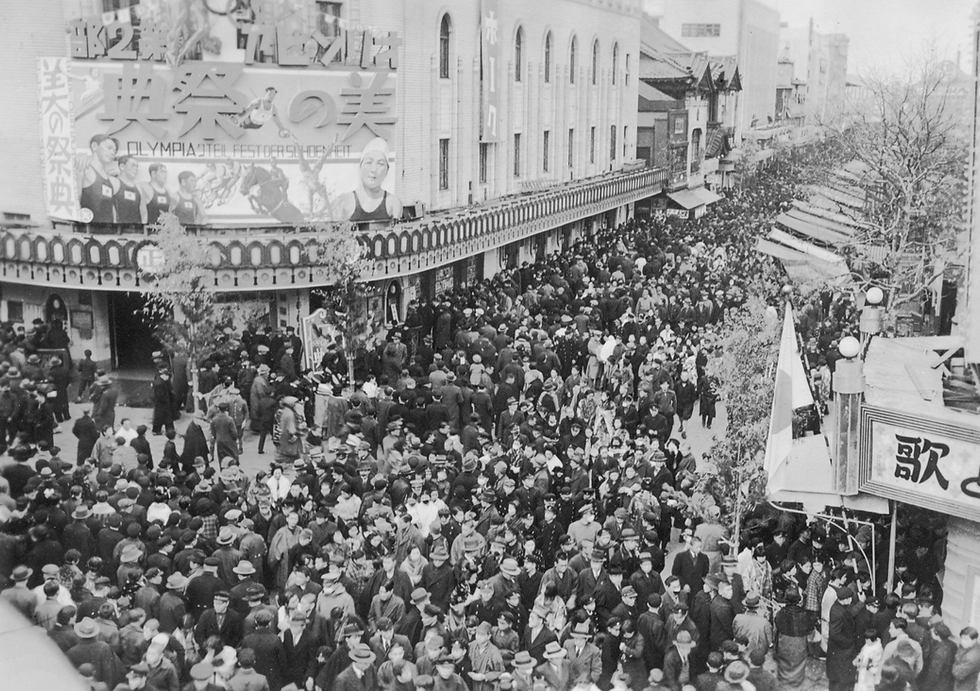
In the Meiji era, theaters and sideshows gathered in Asakusa Park’s Rokku district, and new forms of popular entertainment appeared one after another. The Taisho era brought cinema and Asakusa Opera; the Showa era brought cinema, theater, revues, yose storytelling halls, and variety entertainment. For many years, Asakusa was a place where people came to see what was new in their time.
When Asakusa became an “old town”
Asakusa’s history, however, is not an uninterrupted story of prosperity and ever-growing crowds. Even in modern times, it has faced major crises repeatedly.
The Great Kanto Earthquake of 1923 (Taisho 12) caused extensive damage to Asakusa. Yet the neighborhood recovered. In the Showa era, cinema, theater, revues, yose, and variety entertainment concentrated around Rokku, and Asakusa once again thrived as one of Tokyo’s foremost districts for popular entertainment.
Then the Great Tokyo Air Raid of 1945 (Showa 20) devastated Asakusa once more. Again, people rebuilt. Cinemas and theaters lined the streets of postwar Rokku, worshippers returned to Senso-ji, and shoppers filled Nakamise and the shopping streets.
Even when the neighborhood itself was lost, Asakusa repeatedly rebuilt places where people could gather. In the later Showa years, however, a different kind of crisis emerged. The spread of television, the decline of the film industry, and changes in Tokyo’s urban structure shifted the centers of entertainment and youth culture toward Shinjuku, Shibuya, and Ikebukuro. Rokku’s cinemas and theaters gradually disappeared, and Asakusa experienced a long period of stagnation from late Showa into Heisei.
Once a place where new culture emerged, Asakusa gradually came to be seen as an “old town.” Yet the culture it had nurtured over so many years had not disappeared.
Devotion to Senso-ji; festivals such as the Sanja Matsuri; the geisha district; yose and variety entertainment; craftsmanship; the trade of Nakamise and the shopping streets; food culture; souvenirs; kimono; alleyways; and shops carried on through generations. From the time people began gathering around Senso-ji, through the medieval, Edo, Meiji, Taisho, and Showa periods, layer upon layer of everyday life had shaped Asakusa. Even after the neighborhood’s momentum changed, these traditions continued in the lives of its people.
Then, in the later Heisei years, the times themselves began to change.
As cities around the world developed and their streets and ways of life grew increasingly similar, Asakusa still carried its inherited culture in everyday neighborhood life. Things once considered simply “old” began to gain fresh value as expressions of Japan, and as ways of sensing the accumulated time unique to this place.
It was not only Japanese people who discovered that value. Seeking an encounter with the Japanese culture alive in Asakusa, people now began arriving from around the world.
In the Reiwa era, people gather from across the world
The culture Asakusa has cultivated over its long history now makes it one of Japan’s most popular destinations for inbound tourism, attracting visitors from around the world. The crowds are reflected in the figures. According to tourism statistics released by Taito City in 2025, the ward received 41.21 million visitors in 2024. Of these, 6.4 million were international visitors, a 45% increase over the previous year. Taito City, which includes Asakusa, now draws enormous numbers of visitors from Japan and abroad.
People once gathered here out of devotion to Kannon. In the Edo period, they came for worship, trade, and entertainment. In Meiji, Taisho, and Showa, they flocked here from across Japan in search of new popular culture. Now, in Reiwa, people come to Asakusa from around the world to encounter Japanese culture.
What people seek in Asakusa has changed with the times. Yet the new has not simply replaced the old. Each era has added layers of culture to what earlier generations passed down, creating the Asakusa of today. When people gather, trade emerges and culture grows. That culture, in turn, draws more people. Asakusa has moved through the ages by repeating this cycle.
In 1919, Torii Ryuzo saw Asakusa as a “temple city” with a history distinct from Edo’s. More than a century later, following its history through that lens reveals Asakusa not merely as a corner of Edo, but as a town that had been accumulating a history of its own since before the Edo period.
Over a long span of time, Asakusa drew people together, nurtured craftspeople and merchants, and generated trade and culture, passing that energy into the great city of Edo. It continued to change through earthquakes, war damage, and shifting times. Now, in the Reiwa era, it is once again filled with people. This time, they come not only from across Japan, but from across the world.
Asakusa was Asakusa long before the Edo period.
The lively scenes of visitors arriving from around the world today will, perhaps, one day become another page in Asakusa’s long history.

[Sources and Related Links]
Azuma Kagami: a historical chronicle of the Kamakura shogunate.
Tokyo Metropolitan Archives, Tokyo Shishiko: Sangyo-hen (Historical Materials on the City of Tokyo: Industry)
Odawara-shu Shoryo Yakucho: a register of landholdings and assessed obligations compiled by the Odawara Hojo clan in the Sengoku period.
Senso-ji, “The Origins of Senso-ji and a Brief Chronology”
Taito City, Basic Survey Report on Town Planning in the Asakusa District
Planning, research, and writing: ASAKUSA LOVER History Research Desk | © ASAKUSA LOVER


